Something You Know, Have, and Are: The Three Factors of Authentication (and Where Biometrics Fit)
TL;DR
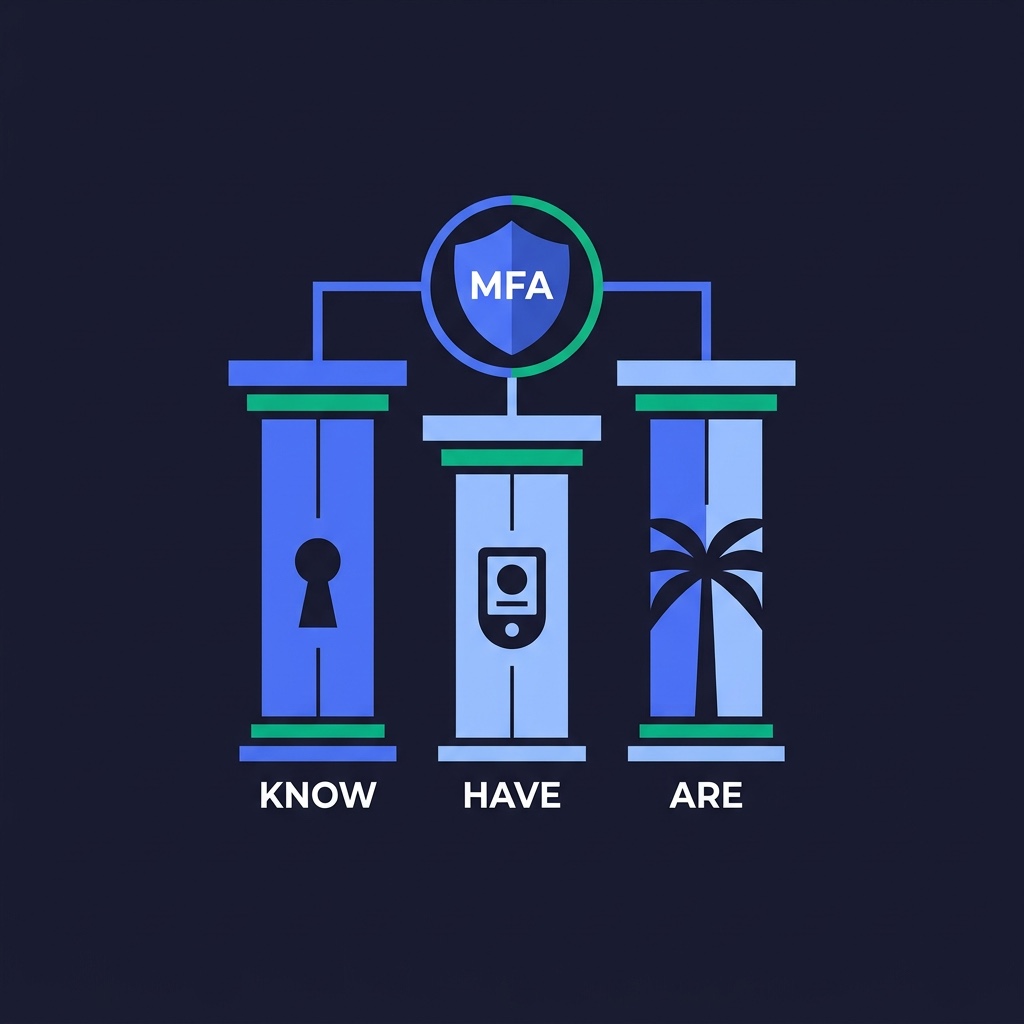
The three factors of authentication are knowledge (something you know, like a password), possession (something you have, like a phone or hardware key), and inherence (something you are, like a fingerprint or palm pattern). Multi-factor authentication (MFA) combines factors from at least two different categories so that compromising one is not enough to breach an account. Biometrics — the inherence factor — have a property the other two lack: they cannot be reissued. You can reset a password or replace a phone, but you cannot issue a new palm or face. That irreversibility is both the core strength of biometrics and the reason they demand careful handling.
What Are the Three Factors of Authentication?
Every authentication method in use today — from a simple password to a sophisticated phishing-resistant key pair — draws from one of three factor categories. These categories are not arbitrary; they map to fundamentally different ways a human can prove identity to a system.
The three factors of authentication are the three independent categories of evidence a person can present to prove identity: knowledge (a secret the person knows), possession (an object the person controls), and inherence (a physical trait the person is). A system that requires evidence from more than one category provides multi-factor authentication.
1. Knowledge — Something You Know
This is the oldest and most familiar factor. A password, a PIN, a security-question answer, or a passphrase — anything that exists as a secret stored in the user's memory and verifiable by the system. Knowledge factors are cheap to deploy, require no hardware, and work on any interface that accepts text input.
Their weakness is structural: anything you know can also be guessed, phished, leaked, or shared. Passwords remain the most breached credential type on the internet. Even strong passwords suffer from reuse — a single credential protecting multiple accounts means one breach cascades across services.
2. Possession — Something You Have
This factor verifies that the user controls a physical or logical object: a mobile phone receiving an SMS code, an authenticator app generating time-based one-time passwords (TOTP), a hardware security key (FIDO2), a smart card, or a passkey stored on a device. The system does not verify a secret the person knows — it verifies that a registered device is present and responding.
Possession factors are harder to phish than knowledge factors because the attacker needs the object, not just the secret. But they introduce a new problem: objects can be lost, stolen, or shared. A phone left unlocked on a desk, a hardware key lent to a colleague — the possession factor confirms the device, not the person holding it.
3. Inherence — Something You Are
This factor verifies a biometric trait of the person: a fingerprint, a face, an iris pattern, a voiceprint, or — in the case of palm recognition — the palm print combined with the vein pattern beneath the skin. The system matches the presented trait against an enrolled template and grants access based on the match.
Inherence factors are unique among the three because they are bound to the person, not to a secret or an object. You cannot forget your palm. You cannot leave your face at home. And — critically — you cannot reissue them, a property explored in detail below.
How the Three Factors Work Together (MFA)
Single-factor authentication asks for one proof. Multi-factor authentication asks for two or more, drawn from different categories. Two passwords are not MFA; they are the same factor twice. A password plus a phone-delivered code is MFA, because it combines knowledge with possession.
The logic is risk separation. If an attacker steals your password (knowledge), they still face the phone (possession). If they steal the phone, they still face the password. Each factor raises the cost of attack independently. The more categories involved, the harder it becomes for a single breach to cascade into full account compromise.
Not all MFA combinations are equally strong. An SMS code (possession) is vulnerable to SIM-swapping. A push notification (possession) is vulnerable to "MFA fatigue" attacks. The most resilient MFA designs in 2026 lean on phishing-resistant methods — FIDO2 hardware keys, passkeys — and, for the highest-assurance moments, an inherence factor that verifies the person directly. For a deeper comparison of MFA methods and their trade-offs, see our Multi-Factor Authentication Explained guide.
The Three Factors Compared
| Factor | What It Is | Example | Reissuability | Primary Weakness |
|---|---|---|---|---|
| Knowledge (something you know) | A secret stored in memory and verified by the system | Password, PIN, security question | Easily reissued — reset via email or admin | Can be guessed, phished, leaked, or reused |
| Possession (something you have) | A device or token whose presence is verified | Phone, authenticator app, hardware key, passkey | Reissuable — replace the device and re-enroll | Can be lost, stolen, or shared; proves device, not person |
| Inherence (something you are) | A biometric trait matched against an enrolled template | Fingerprint, face, palm print and vein | Cannot be reissued — the trait is permanent | Requires a sensor; compromised templates cannot be "reset" |
Where Biometrics Fit — and the Property No Other Factor Has
Biometrics sit in the inherence category, and they share one structural property that neither knowledge nor possession factors possess: they cannot be reissued.
If your password is compromised, you reset it. If your phone is stolen, you deactivate the old device and enroll a new one. The old credential is revoked and a fresh one takes its place. The system returns to a trusted state.
If your biometric template is compromised — through a data breach, a leaked template, or a successful spoof — there is no "reset" button. You cannot grow a new fingerprint. You cannot reissue your face. The trait is permanently and irrevocably yours, which means a compromised biometric is compromised for life. This is the paradox at the heart of inherence: the same permanence that makes biometrics impossible to forget or lose also makes them impossible to replace.
This property has two practical consequences for authentication design.
First, biometric template protection is non-negotiable. Well-designed systems store only mathematical templates — not raw images — and apply encryption, hashing, and on-device or in-region processing to ensure a stolen template cannot be reverse-engineered or replayed. Under frameworks like GDPR, PIPL, and LGPD, biometric data is classified as sensitive personal data, and the handling obligations reflect that classification. Any organization deploying a biometric factor should verify that the vendor's data architecture meets these requirements before enrollment begins.
Second, biometrics are strongest when paired with the other factors, not deployed alone. Because a compromised biometric cannot be reissued, the safest design uses inherence as one layer in a multi-factor stack — not as a standalone credential. A palm scan that confirms "who you are" gains resilience when combined with a passkey that confirms "what you have." Each factor compensates for the other's weakness: the biometric proves the person, the device factor proves the credential, and neither alone is sufficient to grant access.
For a broader discussion of how biometric factors complement passkeys and passwords, see our Passwordless vs Passkey guide.
Why This Matters for 2026 Authentication Design
The passwordless trend has accelerated sharply. The FIDO Alliance reported 5 billion passkeys in active use by mid-2026, and major platforms have made passkeys the default for new accounts. Passkeys — a possession factor anchored to a device — eliminate phishing, reuse, and breach-exposure risks that plague passwords. For personal-device login, they are a decisive upgrade.
But passkeys expose the same gap that every possession factor exposes: they prove the device is present, not the person. A stolen, unlocked phone or an unattended laptop can, in principle, be used by anyone. On a shared terminal — a retail POS, a clinic check-in kiosk, an office turnstile, an ATM — there is no personal device to hold the passkey at all.
This is where the inherence factor becomes decisive in 2026 architecture. When the device model breaks down, only a biometric can bind the action to a specific, present human. And among biometrics, palm recognition — which reads both surface palm print and subsurface vein patterns — offers a contactless inherence factor that is significantly harder to spoof than surface-only biometrics, because the vein pattern has no public image dataset and cannot be photographed from a distance.
The direction of travel is clear: passkeys as the default for personal devices, and an identity-grade inherence factor for the shared terminals and high-risk approvals where possession alone is insufficient. The three-factor framework is not a historical artifact — it is the map that tells you which factor to deploy where.
Where Palm Recognition Fits
Palm recognition is a contactless biometric that identifies a person from their palm print combined with the vein pattern beneath the skin. As an inherence factor, it is most valuable in the scenarios where possession factors break down and where a high-assurance "who you are" check is needed on a shared or public terminal.
- High-value payment authentication. At checkout or transaction approval, a palm scan binds the payment to the enrolled person without requiring a phone or card. See PalmAI PayMax features.
- Identity verification and step-up. For regulated onboarding, privileged access, or account recovery, a palm check provides an identity-grade inherence signal layered on existing factors. See PalmAI KYCMax features.
- Shared-terminal access control. Office turnstiles, campus gates, and building entry points where employees do not carry a personal device for authentication. Explore PalmAI's industries and deployment patterns.
- Edge and offline access. Smart-lock and on-premise scenarios where the inherence check must run without cloud connectivity. See PalmAI SmartLock and Standard.
Palm recognition does not replace knowledge or possession factors. It supplies the one factor category — inherence — that the others structurally cannot, at the moments that most need it.
Limitations and Considerations
- Palm is a factor, not a full MFA stack. It provides inherence; a complete authentication design still combines it with knowledge and/or possession factors. Relying on any single factor — including biometrics — is not multi-factor authentication.
- It requires a sensor. Unlike a password or an SMS code, palm verification needs a dedicated reader at the point of authentication. This constrains deployment to locations where hardware can be installed.
- Enrollment is one-time and in person. There is no fully remote palm enrollment path. This is a design strength (it binds the biometric to a verified physical presence) but a logistical consideration for large-scale rollouts.
- Non-reissuability cuts both ways. Because a palm pattern cannot be reissued, template security and data-handling practices are critical. Organizations should confirm template-only storage, no raw-image retention, and compliance with GDPR, PIPL, LGPD, and equivalent frameworks before deployment.
- Compliance mapping is required. Biometric data is sensitive personal data under most privacy regimes. Consent, retention, necessity, and cross-border transfer should be reviewed with a data protection officer.
Frequently Asked Questions
What are the three factors of authentication?
The three authentication factors are knowledge (something you know, such as a password or PIN), possession (something you have, such as a phone or hardware key), and inherence (something you are, such as a fingerprint, face, or palm pattern). Multi-factor authentication requires evidence from at least two different categories.
Why can't biometrics be reissued like passwords or tokens?
A password is a secret you chose and can change. A phone is an object you own and can replace. A biometric trait — your fingerprint, your face, your palm vein pattern — is physically permanent. If the credential is a mathematical template derived from that trait, a compromise means the underlying trait cannot be "reset." This is why biometric template protection and multi-factor layering are essential.
Is a biometric alone considered multi-factor authentication?
No. A biometric is a single factor — the inherence factor. It becomes MFA only when combined with a factor from a different category, such as a password (knowledge) or a device (possession). On its own, even a strong biometric is single-factor authentication.
How does palm recognition work as an authentication factor?
Palm recognition is a contactless biometric that reads the surface palm print and, with dual-modal capture, the vein pattern beneath the skin using near-infrared light. The system matches the presented palm against an enrolled template and grants access based on the match. It serves as the inherence factor in an MFA stack, most useful on shared terminals and for high-risk step-up where possession factors alone are insufficient.
What makes palm recognition harder to spoof than surface biometrics?
Surface biometrics like fingerprints and faces can potentially be photographed or lifted from everyday surfaces. Palm vein patterns sit beneath the skin, require near-infrared illumination to capture, and have no public image dataset for an attacker to reference. This makes palm recognition significantly harder to spoof than surface-only biometrics — though no biometric is entirely immune to attack, which is why template protection and multi-factor layering remain essential.
Related Resources
- Multi-Factor Authentication Explained: The Three Factors and What Comes After Passwords
- Passwordless vs Passkey: A 2026 Biometric Authentication Guide
- PalmAI Industries and Deployment Patterns
- See PalmAI KYCMax Features
About Tencent PalmAI
Tencent PalmAI is an AI-powered palm recognition service combining palm print and palm vein identification, protected by 90+ patents and validated through 20+ peer-reviewed conference papers. Built on dual-modal recognition that reads both surface and subsurface patterns, PalmAI delivers an inherence factor that is significantly harder to spoof than surface-only biometrics — supplying the one authentication factor category that knowledge and possession cannot provide.