What Actually Gets Stored When You Enroll a Biometric? Templates, Hashing, and Irreversibility
Quick Answer
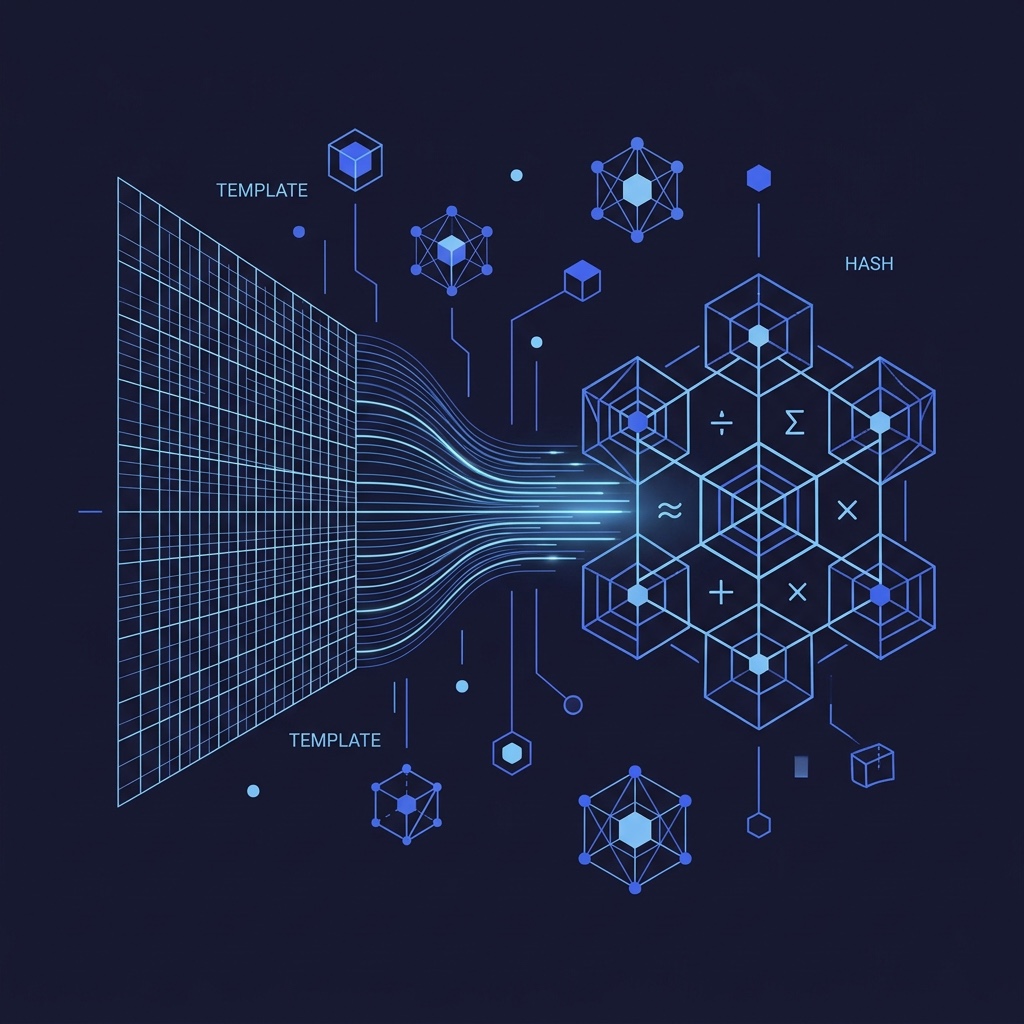
A biometric template is a mathematical representation of your physical traits — not a photograph or a recording. When you enroll a palm, the system extracts distinctive features, converts them into a numeric vector, and stores only that abstract representation. The original image is discarded. Through one-way transformation and hashing, a well-designed template cannot be reversed to reconstruct your palm print or vein pattern. That is the core reason biometric data storage can be considered safe: what is stored is not what was captured, and what was captured is not kept.
What Is a Biometric Template?
A biometric template is a compact, mathematical representation of a person's physiological characteristics that is used for identity matching rather than image storage. When you enroll your palm in a recognition system, the sensor captures an image of your palm print and, in dual-modal systems, the vein pattern beneath the skin using near-infrared light. That image is processed by a feature-extraction algorithm, which identifies distinctive points and patterns — ridge endings, bifurcations, vein-branch structures — and converts them into a set of numeric values. This numeric set is the template.
A biometric template is a mathematical representation of physiological features that enables identity matching without retaining the original biometric image, providing a non-reversible credential for authentication and verification systems.
The critical distinction: the template is not a picture. You cannot view it, print it, or reconstruct a palm image from it. It is closer in nature to a hashed password than to a photograph — a one-directional derivative that serves matching but not reconstruction.
This is why the question "is biometric data safe?" often starts from a misconception. People imagine a database of palm photographs. In practice, well-designed systems store only mathematical abstractions, and the raw capture is deleted immediately after enrollment.
How Does Biometric Template Storage Work?
The enrollment and matching pipeline operates in three stages:
-
Capture and feature extraction. When a user presents their palm, the sensor images both the surface palm print and, in dual-modal systems, the subcutaneous vein pattern. A feature-extraction algorithm identifies distinctive characteristics — geometry, texture, vein-branch topology — and encodes them as a high-dimensional numeric vector. This vector is the template. The original image is not persisted.
-
One-way transformation. Before storage, the template undergoes further transformation — typically a cryptographic hash or a non-invertible mathematical function. This means that even if an attacker obtained the stored template, they could not run the process backward to produce the original feature vector, let alone a palm image. The transformation is designed to be computationally infeasible to reverse.
-
Matching, not retrieval. During authentication, the system captures a new palm image, extracts a fresh template from it, and compares the two mathematical representations. The system never "looks up" a stored image and visually compares them. It computes the distance between two vectors and checks whether it falls within an acceptance threshold. This is why a stolen template cannot be used to impersonate someone in the way a stolen password can — it is not a reusable secret that can be typed into a login field.
The on-device vs. server-side distinction adds another layer:
-
On-device storage keeps the template in a secure hardware enclave on the user's device (a smartphone secure element, a smart lock's local chip). The biometric never leaves the device. Authentication is a local yes/no signal sent to the requesting application. This is the model used by consumer devices like smartphones and smart locks.
-
Server-side storage keeps the encrypted template on a backend server, enabling matching across shared terminals where no single device "owns" the credential. This is the model used for palm-based payment at retail, patient check-in at hospitals, and turnstile access at office buildings — scenarios where a user interacts with shared infrastructure rather than their personal phone.
On-Device vs. Server-Side Template Storage: A Comparison
| Dimension | On-Device Storage | Server-Side Storage |
|---|---|---|
| Where the template lives | Secure hardware enclave on a personal device | Encrypted database on a backend server |
| Biometric leaves the device? | No — matching happens locally | Template is transmitted and matched server-side |
| Best-fit scenario | Personal devices, smart locks, individual workstations | Shared terminals, POS checkout, clinic check-in, turnstiles |
| Scalability across terminals | Low — each user must enroll on each device | High — enroll once, authenticate at any connected terminal |
| User enrollment burden | Per-device enrollment required | Single enrollment, multi-terminal access |
| Data sovereignty control | Inherent — data never leaves the user's hardware | Requires encryption-at-rest, in-transit TLS, and in-region hosting |
Neither model is universally superior. On-device storage offers inherent privacy but cannot serve shared infrastructure. Server-side storage enables large-scale, multi-terminal deployments but demands rigorous encryption, access control, and compliance practices. The right choice depends on the deployment context — and many mature systems use both: on-device for personal-device login, server-side for shared-terminal verification.
Why Is Biometric Template Storage Secure?
The security of biometric data storage rests on three properties that, taken together, make a well-designed template significantly harder to exploit than a password database.
Irreversibility. The transformation from raw image to template is a one-way function. A hash or non-invertible transform ensures that the stored data cannot be mathematically reversed to produce the original feature vector or the original palm image. Even if an attacker exfiltrates the entire template database, they walk away with mathematical abstractions — not photographs.
Non-linkability (in well-designed systems). A template generated for one application should not be cross-matchable against a template generated for a different application, even if both originate from the same palm. This is achieved through application-specific salting or transform parameters. The result: a breach in one system does not compromise the user's identity across every other system where they have enrolled.
No raw-image retention. The most fundamental safeguard is also the simplest: the original palm image is discarded after feature extraction. There is nothing to leak because nothing was kept. A server that stores only hashed templates has no photographs to steal — and no photographs to produce via reconstruction.
For context, Tencent PalmAI's dual-modal approach combines palm print and palm vein recognition, capturing both surface and subcutaneous features. The Finance-grade deployment achieves a False Acceptance Rate (FAR) below 1 in 100 million — meaning the probability of a random impostor being accepted as a legitimate user is less than 0.0000001%. The vein pattern, in particular, is internal to the body and significantly harder to spoof than surface-only biometrics, because it requires imaging blood-vessel structures beneath the skin rather than replicating a visible surface pattern.
To understand how FAR and FRR interact to determine real-world accuracy, read: FAR, FRR, and Biometric Accuracy Explained.
The Regulatory Context: Why Template-Only Storage Is Becoming a Legal Floor
Privacy-by-design is no longer a differentiator — it is increasingly a legal requirement. The EU AI Act, which classifies certain biometric identification systems as high-risk, mandates strict data protection measures including minimization, encryption, and purpose limitation. GDPR Article 25 explicitly requires data protection by design and by default, which in practice means collecting and retaining the minimum biometric data necessary and deleting raw captures after template extraction.
These regulations converge on a common principle: systems should store mathematical representations, not raw biometric images. Template-only storage with irreversibility is the technical mechanism that satisfies this principle. For organizations deploying palm recognition across multiple jurisdictions, choosing a system that discards raw images and stores only non-reversible templates is not just a security decision — it is a compliance strategy.
Application Scenarios
The on-device vs. server-side distinction maps directly to real-world product choices:
-
Smart Locks (on-device). SmartLock stores templates locally on the lock's embedded chip. The palm data never leaves the device, recognition completes in under 0.8 seconds, and no network connection is required. This is the purest on-device model — ideal for residential and small-office access where privacy is paramount and enrollment is per-device.
-
Enterprise Access Control (hybrid). Standard supports on-premise deployment for mid-scale door and turnstile access. Templates can be stored on local servers within the building's network, keeping biometric data inside the organization's perimeter while enabling multi-terminal enrollment.
-
High-Volume Payment Authentication (server-side). PayMax is built for retail and finance scenarios where a user enrolls once and authenticates at any connected POS terminal. Server-side encrypted template storage enables this scale — with FAR below 1 in 100 million for finance-grade deployments. Explore PalmAI's retail and finance solutions for sector-specific deployments.
-
Identity Verification at Scale (server-side). KYCMax handles large-scale identity verification for healthcare, education, and membership programs. Templates are encrypted and stored server-side to support check-in across multiple facilities — for example, a hospital network where a patient enrolls once and is recognized at any clinic.
Limitations and Considerations
Template-based biometric storage is not a panacea. Honest assessment requires acknowledging the boundaries:
-
Irreversibility is a design property, not a physical law. The one-way nature of a biometric template depends on the quality of the transform function. A poorly designed or outdated algorithm could, in theory, produce templates that leak more structural information than necessary. Organizations should verify that their vendor uses non-invertible transforms that meet recognized standards — and should be skeptical of any system that cannot clearly explain its template-generation approach at a conceptual level.
-
Biometrics are not replaceable like passwords. If a password is compromised, you change it. You cannot change your palm. This is why template security — irreversibility, non-linkability, encryption-at-rest — is not optional hardening. It is the core safeguard that prevents a single breach from permanently compromising a person's biometric identity.
-
Server-side storage introduces operational responsibilities. Any system that stores templates on a server must implement encryption-at-rest, strict access controls, audit logging, and in-region hosting where data sovereignty laws require it. On-device storage avoids these concerns but sacrifices cross-terminal scalability.
-
Template matching is probabilistic, not deterministic. Unlike a password check (exact match or no match), biometric matching produces a similarity score measured against a threshold. Setting that threshold involves a trade-off between False Acceptance Rate and False Rejection Rate. Organizations must tune this threshold to their risk profile — a topic covered in detail in FAR, FRR, and Biometric Accuracy Explained.
-
Not every scenario needs biometric storage at all. For personal-device login where the user always has their own phone, a passkey unlocked by a local biometric may be sufficient — and it avoids storing any biometric template on a server at all. Read: Passwordless vs Passkey: A Biometric Authentication Guide for a detailed comparison.
Frequently Asked Questions
Is biometric data safe to store on a server?
When stored as a non-reversible mathematical template — not a raw image — biometric data can be stored safely on a server. The key safeguards are: the original image is discarded after enrollment, the template is produced through a one-way transform that cannot be reversed, and the stored template is encrypted at rest. No system is perfectly secure, but template-only storage with irreversibility and encryption is a fundamentally different risk profile than storing photographs of palms or faces.
What is the difference between a biometric image and a biometric template?
A biometric image is the raw photograph captured by the sensor — a picture of your palm. A biometric template is a mathematical representation derived from that image: a set of numeric values encoding distinctive features. The image is visual data; the template is abstract data. The image can be viewed and recognized by a human; the template cannot. Well-designed systems discard the image and store only the template.
Can a biometric template be reversed to reconstruct my palm?
In a properly designed system, no. The template is generated through a non-invertible mathematical function — meaning the transformation from image to template cannot be computationally reversed. Even with full access to the stored template and knowledge of the algorithm, reconstructing the original palm image is designed to be infeasible. This property, called irreversibility, is a core requirement of biometric data safety.
What happens to my biometric data if I want to delete it?
In well-designed systems, deleting a biometric profile removes the stored template entirely. Because only the template — not the raw image — was stored, deletion removes all biometric data associated with that user. Organizations should verify that their vendor supports full deletion and revocation, and should confirm whether any backup or audit systems retain template data after a deletion request.
Should biometric templates be stored on-device or on a server?
It depends on the use case. On-device storage keeps biometric data on the user's personal hardware — ideal for smart locks and individual workstations where privacy is paramount. Server-side storage enables shared-terminal scenarios like retail payment, hospital check-in, and office turnstile access where users authenticate at infrastructure they do not own. Many organizations use both: on-device for personal-device login, server-side for shared infrastructure. The choice is a trade-off between privacy isolation and cross-terminal scalability.
Related Resources
- FAR, FRR, and Biometric Accuracy Explained
- Passwordless vs Passkey: A Biometric Authentication Guide
- PalmAI Industry Solutions
- KYCMax Product Features
About Tencent PalmAI
Tencent PalmAI is an AI-powered palm recognition service combining palm print and palm vein identification. By storing only non-reversible mathematical templates and discarding raw images after enrollment, PalmAI is designed to make biometric data storage safe, private, and compliant across regulated industries.