How Bupa Hong Kong Launched the City's First Palm-Based Express Check-In with Tencent PalmAI
Bupa Hong Kong partnered with Tencent PalmAI to deliver the city's first palm-based KYC check-in system — powering Blua Health Express Check-in across 50+ clinics and 400,000+ patients with contactless, zero-error identity verification.
At a Glance
| Dimension | Detail |
|---|---|
| Client | Bupa Hong Kong |
| Industry | Healthcare / Medical insurance |
| Region | Hong Kong SAR |
| Challenge | Slow, error-prone manual check-in for 400,000+ patients across 50+ clinics |
| Solution | Tencent PalmAI Standard + M4 — palm recognition KYC embedded in Bupa's Blua Health Express Check-in kiosk and deeply integrated with Bupa's appointment and patient management platforms |
| Key Result | Hong Kong's first palm-based Express Check-in; contactless, zero-error, zero-delay patient arrival |
| Footprint | 50+ clinics · 400,000+ patients · flagship launch at Bupa's Central medical center |
| Part of | Bupa's "Connected Care" strategy |
Hong Kong Healthcare's Check-In Bottleneck — And Why Palm Recognition Fits
Bupa Hong Kong is one of the city's largest health insurance and healthcare providers, serving over 400,000 members through a network of 50+ clinics and the Quality HealthCare Medical Centre at Bupa's flagship location in Central. In a city known for its pace, patients expect healthcare to feel as seamless as the rest of their day — but the traditional arrival experience does not deliver.
Before PalmAI:
| Pain point | Business impact |
|---|---|
| Manual ID card scans + appointment lookup at the front desk | Queues at peak hours, long wait times for patients already feeling unwell |
| Shared kiosks, paper forms, and physical cards | Hygiene concerns, heightened by post-pandemic patient expectations |
| Errors in matching walk-ins to the correct member record | Rework, mis-routed visits, and frustrated members |
| Fragmented experience across 50+ clinics | Inconsistent check-in standards make scaling "Connected Care" harder |
For Bupa, arrival was the first — and most repeated — moment of truth with every member. Fixing it meant solving for three things at once: speed, hygiene, and accuracy at scale.
→ Explore PalmAI's healthcare solutions
Why Bupa Hong Kong Chose Tencent PalmAI
Bupa evaluated several contactless identity options — face recognition, fingerprint, QR code — against the realities of a busy clinic floor. The selection criteria and PalmAI's response:
- Mask-on, hygienic, contactless — palm recognition works with masks on and without any surface contact, unlike face or fingerprint
- Dual-modal accuracy — combining palm print (surface) and palm vein (sub-dermal vascular pattern) delivers 99.9% accuracy, critical for matching the right patient to the right record
- Production-proven at scale — PalmAI already serves 100M+ registered users, so Bupa was adopting a service hardened in production, not a pilot
- Deep integration, not a bolt-on — PalmAI's Standard solution integrates directly with Bupa's appointment and patient management platforms, enabling true automated check-in, not just identity capture
- Privacy by design — palm vein patterns are hidden under the skin, cannot be photographed or captured covertly, and align with Hong Kong's privacy expectations for health data
How PalmAI Powers Bupa's Blua Health Express Check-in
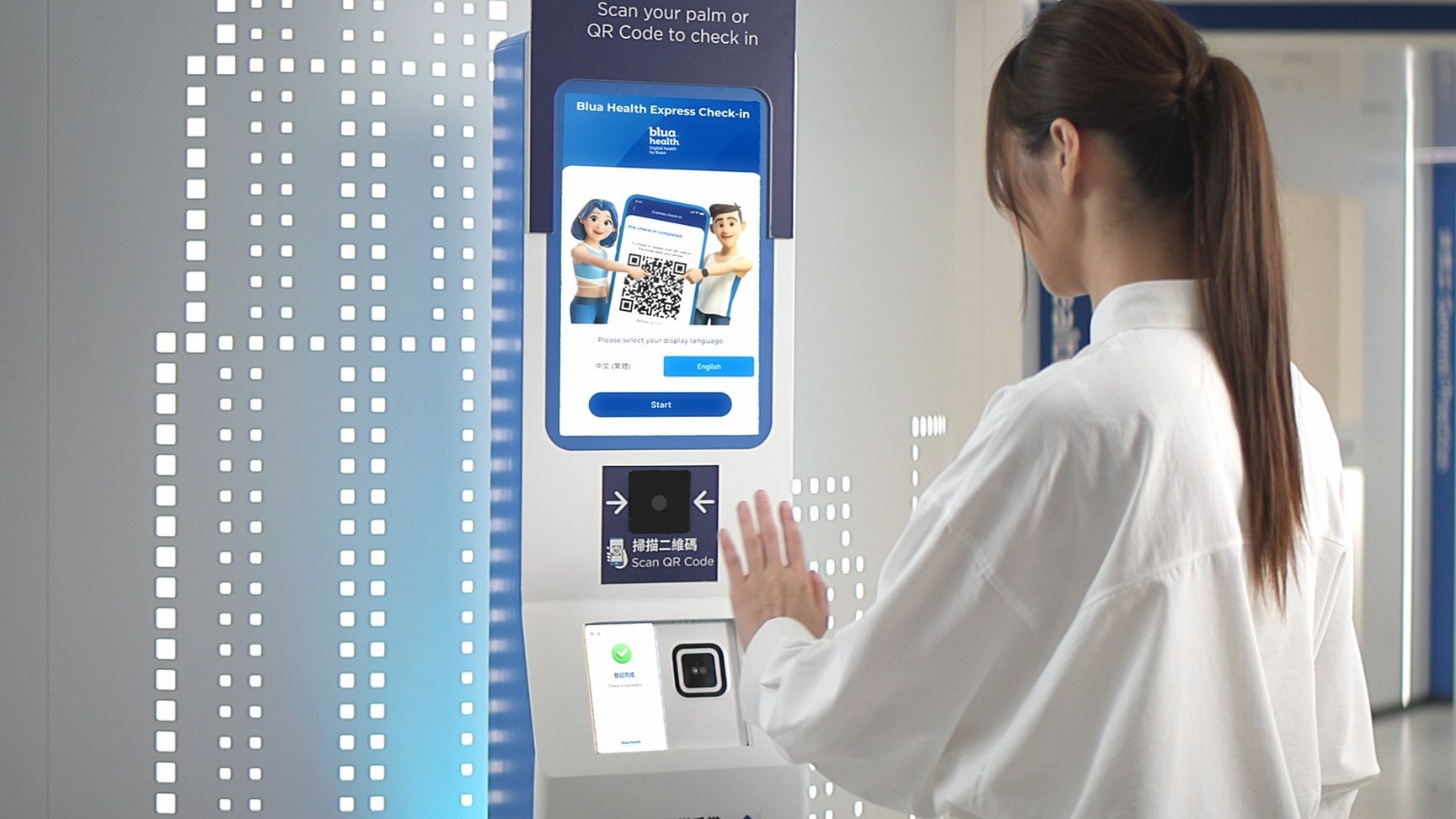
The jointly delivered solution is built on Tencent PalmAI's Standard service + M4 palm recognition module, embedded into Bupa's branded Blua Health Express Check-in kiosk at clinic reception areas and deeply integrated with Bupa's backend systems. Rather than replacing the check-in desk, it upgrades the entire arrival flow into a single, seamless gesture — with a bilingual (English / 繁體中文) self-service interface that also falls back to QR code check-in for patients who have not yet enrolled.
Technical implementation:
| Component | Detail |
|---|---|
| Biometric modality | Palm print + palm vein (dual-modal) |
| Device | PalmAI M4 palm recognition module, embedded into Bupa's Blua Health Express Check-in kiosk |
| Solution tier | PalmAI Standard — cloud-connected service |
| Verification speed | 2–10 seconds from palm presentation to check-in complete |
| System integration | Bupa appointment system + patient management platform |
| Self-service UI | Bilingual (English / 繁體中文), with QR code check-in as fallback for non-enrolled patients |
| Enrollment | One-time self-registration linked to Hong Kong ID and membership record |
| Deployment scope | 50+ Bupa clinics; flagship rollout at Central medical center |
| Compliance | Contactless, hygienic, privacy-preserving sub-dermal biometric |
Patient flow:
- Enroll once — on first visit, the patient registers their palm at a Blua Health Express Check-in kiosk, linked to their Bupa membership and Hong Kong ID
- Arrive — at any Bupa clinic, the patient selects their language, then hovers their palm over the PalmAI module on the kiosk
- Verified in seconds — appointment, membership, and clinical record are automatically matched; a QR code path remains available for patients who have not yet enrolled
- Check-in complete — the patient proceeds directly to the waiting area; no forms, no cards, no queueing at the counter
Results: Hong Kong's First Palm-Based Healthcare Check-In
The rollout, launched at Bupa's flagship Central medical center and extended across Bupa's Hong Kong clinic network, delivered measurable improvements to the patient arrival experience.
| Dimension | Before PalmAI | With PalmAI |
|---|---|---|
| Identity verification | Manual ID card scan + lookup | Palm recognition check-in in 2–10 seconds |
| Physical contact | Shared kiosks, forms, cards | Fully contactless, mask-on capable |
| Check-in accuracy | Prone to mismatches and rework | 99.9% accuracy with dual-modal recognition |
| Clinic coverage | Inconsistent across locations | Unified Express Check-In across 50+ clinics |
| Member reach | — | 400,000+ patients enabled |
| Industry standing | — | Hong Kong's first palm-based healthcare KYC system |
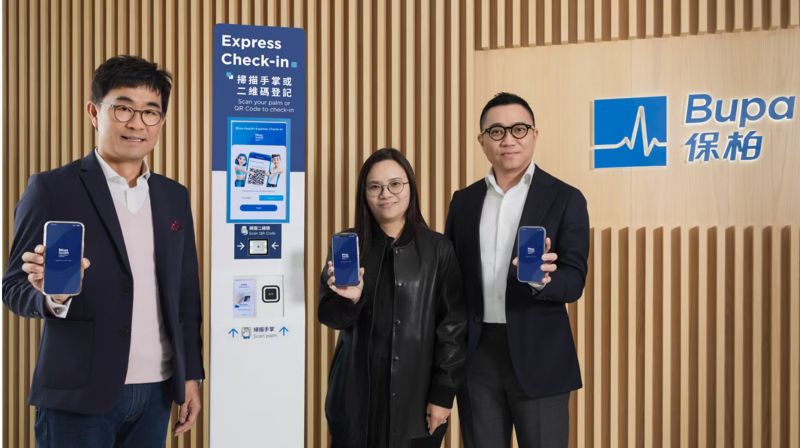
"Launching Hong Kong’s first palm-based check-in service is a proud milestone for Bupa and reinforces our leadership in digital healthcare. This partnership with Tencent advances our ‘Connected Care’ strategy and our vision of helping people live longer, healthier, happier lives. By introducing this breakthrough technology, we are setting a new benchmark for convenience and safety—customers can check in faster, without ID cards or physical interaction, and enjoy a truly contactless experience. Fully integrated with the Blua Health app, this innovation reflects our commitment to putting customers first and creating future-ready healthcare solutions." — Yvonne Leung, Chief Customer, Data & Digital Officer at Bupa Hong Kong
The flagship launch also set the foundation for broader adoption of palm-based identity in Hong Kong's healthcare sector — with discussions extending to other leading local hospital groups.
What "Connected Care" Looks Like, One Palm at a Time
Bupa's partnership with Tencent PalmAI signals a broader shift in how Hong Kong — and the Greater Bay Area — will approach patient-facing digital health:
- From arrival to end-to-end journey — the same palm that verifies a patient at reception can, over time, be extended to prescription pickup, payment, and secure access to clinical records
- From a flagship site to a network standard — with the Central flagship proven, Express Check-In becomes the default standard across Bupa's 50+ Hong Kong clinics
- A blueprint for Hong Kong healthcare — as the city's first palm-based KYC healthcare system, Bupa's deployment sets a reference that other Hong Kong providers can build on
For Hong Kong's healthcare ecosystem, this is more than a check-in upgrade. It is an early, concrete answer to the question of what "Connected Care" looks like when AI and biometrics are applied with patient experience — not surveillance — as the design goal.
Ready to bring palm recognition to your healthcare network? Use the contact form on this page to reach the Tencent PalmAI team.
FAQ
How does palm recognition work for healthcare check-in?
Tencent PalmAI uses dual-modal biometrics — combining palm print (the surface pattern) and palm vein (the sub-dermal vascular structure). A patient hovers their hand over an M4 palm scanner; within 2-10s, the system matches the palm to the patient's record in the hospital or clinic's appointment system and completes check-in automatically, with zero physical contact.
Is palm recognition more private than face or fingerprint in a clinic setting?
Yes. Palm vein patterns are hidden beneath the skin and cannot be captured by a camera or lifted from surfaces, unlike face or fingerprint. This makes palm recognition particularly well suited to health data contexts, where patients expect strict privacy. PalmAI stores biometric templates — not raw palm images — and combines two independent modalities (print + vein) to deliver zero misidentifications in production.
How long does it take to deploy PalmAI Express Check-In across a healthcare network?
PalmAI's Standard solution is designed for integration with existing appointment and patient management systems via SDK and API. Bupa began with a flagship site (Central medical center) and then scaled across 50+ clinics serving 400,000+ patients. The deployment pattern — start with a reference site, then extend — is a common approach for healthcare networks evaluating palm-based KYC.
Related Reading
-
How palm recognition removed the digital barrier for Singapore's seniors — patient-adjacent care environment, elderly-friendly enrollment
Media Coverage
- Interview video — Tencent Cloud × Bupa Hong Kong: Express Check-In launch
- LinkedIn announcement — Tencent Cloud × Bupa partnership post
- Facebook — Tencent Cloud × Bupa partnership
- X (Twitter) — @TencentCloud: Bupa Hong Kong Express Check-In
About Tencent PalmAI
Tencent PalmAI is an AI-powered palm recognition service combining palm print and palm vein identification. Deployed across retail, healthcare, and banking sectors worldwide, PalmAI delivers touchless identity verification with 99.9% accuracy — and is now powering Hong Kong's first palm-based healthcare check-in with Bupa.