Opensys Brings Palm Payment to Malaysian Retail and ATMs with PalmAI
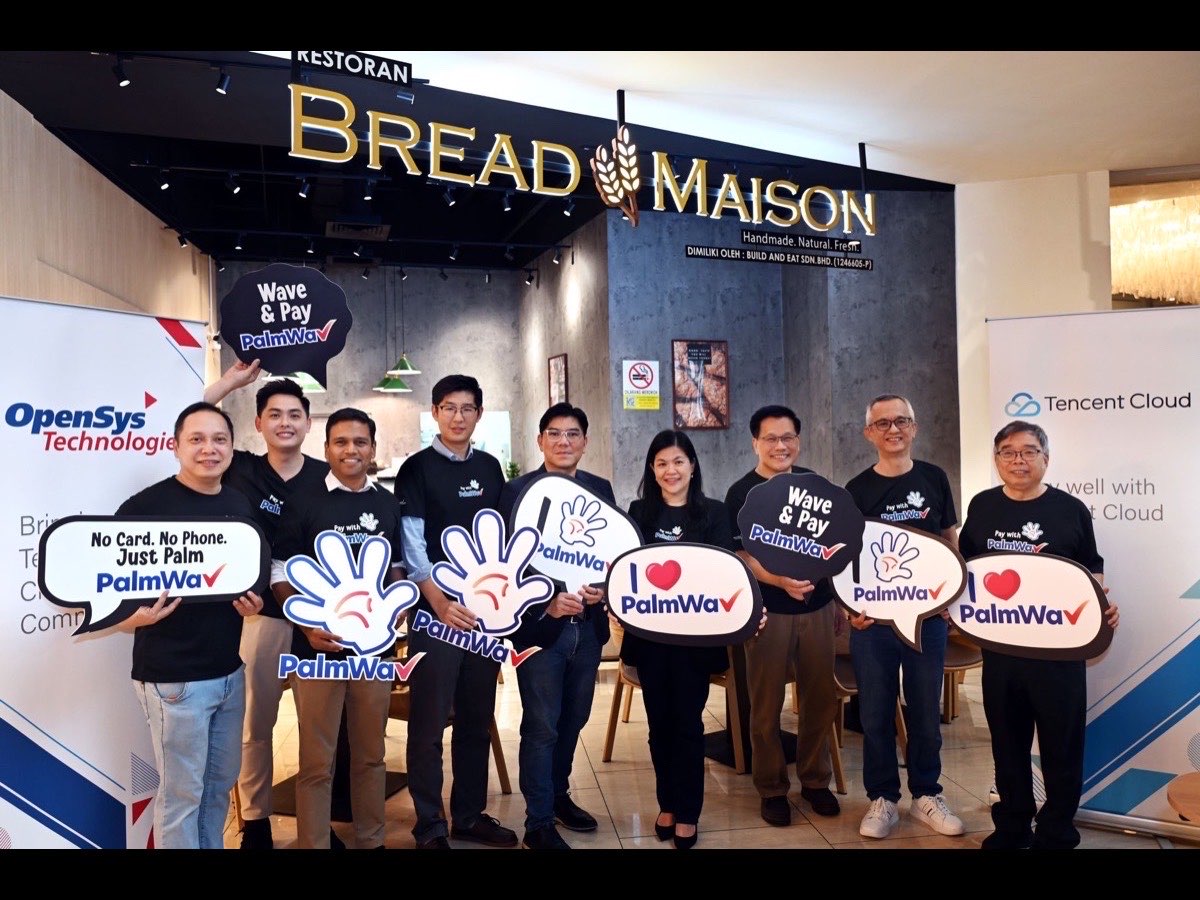
Palm payment is an AI-powered contactless transaction technology that uses palm print and palm vein dual-modal recognition as the payment credential. Opensys (M) Berhad, Malaysia's leading payment integrator, partnered with Tencent PalmAI to deliver palm-based payment, EV charging activation, and ATM access — replacing cards and PINs with a 1-second palm wave.
At a Glance
| Dimension | Detail |
|---|---|
| Client | Opensys (M) Berhad |
| Industry | Finance & Payment Integration |
| Region | Malaysia |
| Challenge | Card fraud, slow cash handling, and PIN-based vulnerabilities across retail, EV charging, and ATM channels |
| Solution | Tencent PalmAI Standard + M4 for retail palm payment; PayMax + O2 for high-volume transaction processing |
| Key Result | Contactless palm payment across retail, EV charging, and ATM — eliminating card skimming and enabling real-time 1s verification |
| Scope | Multi-channel deployment: retail POS, EV charging stations, ATM terminals |
Malaysia's Payment Fraud Problem — Why Cards and PINs Fall Short
Opensys (M) Berhad is one of Malaysia's foremost payment solution integrators, connecting merchants, banks, and service providers through self-service kiosks, ATM networks, and payment terminals nationwide. The company serves a market where card fraud remains a persistent challenge — credit card skimming, cloned cards, and stolen PINs cost Malaysian consumers and banks millions annually.
Before PalmAI:
| Pain point | Business impact |
|---|---|
| Credit card skimming at retail POS terminals | Financial losses for consumers and chargebacks for merchants |
| ATM card trapping and PIN theft | Customer distrust, card replacement costs, branch escalation |
| Cash-heavy EV charging workflows | Slow activation, high operational overhead at charging stations |
| No unified identity layer across payment channels | Each channel requires separate credentials — cards, PINs, apps |
For Opensys, the opportunity was clear: a single biometric credential that could replace cards, PINs, and apps across every payment touchpoint — without the hygiene and privacy concerns of fingerprint or face recognition.
→ Explore PalmAI's finance and banking solutions
Why a Payment Integrator Chose Palm Over Fingerprint and Face
Opensys evaluated multiple biometric modalities — fingerprint, face, iris — before selecting palm recognition. The comparison came down to four dimensions critical for multi-channel payment:
Palm Payment vs Alternatives for Retail and ATM Environments
| Criterion | Card + PIN | Fingerprint | Face Recognition | Palm Recognition |
|---|---|---|---|---|
| Fraud resistance | Low — cards skimmable, PINs stealable | Medium — silicone replicas possible | Medium — spoofable with photos/masks | High — sub-dermal veins cannot be copied |
| Contactless | No — card insert + PIN keypad | No — finger must press sensor | Yes — but raises surveillance concerns | Yes — no surface contact |
| Cross-channel portability | Separate card per bank/channel | Device-bound (lock-specific) | Privacy barriers limit adoption | Single enrollment works everywhere |
| Condition reliability | N/A | Fails with wet/dry/greasy hands | Fails in low light; mask issues | Condition-independent |
| Compliance readiness | PCI-DSS for card data | Varies | Privacy regulations restrict facial data | PDPA-compatible; consent-based |
Where palm recognition is not the right fit: For micro-transactions under $1 where enrollment friction outweighs benefit, or for users under age 8 whose vein patterns may not be fully developed, card/QR fallback remains appropriate.
Based on this evaluation, Opensys selected palm recognition for its combination of fraud resistance, contactless operation, and cross-channel unification:
- Fraud-proof by design — palm vein patterns are sub-dermal and cannot be photographed, skimmed, or replicated, unlike card numbers or fingerprints
- Contactless and hygienic — no surface touch required, critical for high-traffic retail and public ATM environments
- Cross-channel versatility — a single palm enrollment works across retail POS, EV charging kiosks, and ATM terminals, unifying the customer identity
- Finance-grade security — PalmAI's dual-modal recognition (palm print + palm vein) achieves FAR of 1 in 100 million, meeting financial-sector compliance requirements
- Real-time verification — 1-second recognition eliminates checkout delays in high-volume retail environments
How PalmAI Powers Opensys's PalmWav Ecosystem
Tencent PalmAI's Standard service with M4 palm recognition module, combined with the PayMax cloud platform for large-scale transaction processing, powers Opensys's branded PalmWav payment ecosystem across three core scenarios.
Technical implementation:
| Component | Detail |
|---|---|
| Biometric modality | Palm print + palm vein (dual-modal) |
| Device | PalmAI M4 module integrated into Opensys payment terminals |
| Solution tier | PalmAI Standard + PayMax (high-volume cloud processing) |
| Verification speed | ~1 second from palm presentation to transaction authorization |
| Security standard | FAR 1 in 100M, NFFC certified |
| Deployment model | Cloud-connected, multi-tenant |
Three deployment scenarios:
1. Retail Palm Payment
Consumers register their palm once at any Opensys-powered terminal. At checkout, a palm wave replaces card swipe or PIN entry — authorization completes in approximately 1 second. No card can be skimmed because no card is used.
2. EV Charging Activation
At EV charging stations, drivers authenticate with their palm to start a session — replacing cash, apps, or RFID cards. The palm credential links directly to their payment account, enabling automated billing without manual interaction.
3. ATM Palm Access
At ATM terminals, palm recognition replaces the physical card entirely. Users access their accounts by scanning their palm — eliminating card trapping, skimming devices, and PIN shoulder-surfing. Even if an ATM is compromised with a skimmer, there is no card to skim.
Opensys's Results: Eliminating Card Fraud Across Payment Channels
| Metric | Before | After | Improvement |
|---|---|---|---|
| Card fraud exposure at POS | Physical cards vulnerable to skimming | No card present — palm-only authentication | Card fraud vector eliminated |
| ATM card trapping risk | Card slot exploits active | No physical card required | Physical ATM fraud eliminated |
| Payment speed | 5–8s (card insert + PIN entry) | ~1s palm wave | ~80% faster |
| EV charging activation | Cash or app-based (30s+ setup) | Palm wave to start | Instant activation |
| Customer credential count | Separate card + PIN per channel | Single palm enrollment, all channels | Unified identity |
What Enterprises Should Evaluate Before Deploying Palm Payment
Before adopting palm-based payment at scale, payment integrators and merchants should consider:
- Enrollment UX — first-time palm registration must be intuitive and fast (under 30 seconds) to minimize drop-off at terminals
- Fallback methods — not all customers will enroll immediately; hybrid terminals supporting both palm and card ensure business continuity
- Privacy communication — proactively explain to end-users that palm vein data is stored as encrypted templates, not raw images, and cannot be reverse-engineered
- Network requirements — cloud-connected palm verification requires reliable connectivity; evaluate latency tolerance for offline-first scenarios
- Regulatory alignment — confirm that palm biometric collection complies with Malaysia's Personal Data Protection Act (PDPA) and any sector-specific financial regulations
What's Next for Opensys and PalmAI in Malaysia
As Malaysia's digital payment ecosystem matures, Opensys aims to expand the PalmWav platform across additional merchant categories and transit networks. The vision: a single palm wave handles every financial interaction a Malaysian consumer encounters in daily life — from morning coffee to evening commute — with no cards, no phones, and no PINs.
→ Ready to bring palm payment to your payment network? Discuss palm biometric integration for your payment terminals using the contact form on this page.
FAQ
How does palm payment work at Opensys retail terminals in Malaysia?
Palm payment at Opensys-powered terminals uses Tencent PalmAI's dual-modal recognition — combining palm print and palm vein patterns — to verify a customer's identity in approximately 1 second. The customer registers their palm once, linking it to their payment account. At checkout, they simply hover their hand over the PalmAI M4 module embedded in the terminal. No card, phone, or PIN is required.
Is palm recognition more secure than card-based payment for preventing fraud?
Palm vein patterns are sub-dermal biological signals that cannot be photographed, copied, or skimmed — unlike card numbers, magnetic stripes, or PINs. Tencent PalmAI achieves a False Acceptance Rate of 1 in 100 million (FAR 0.000001%), significantly exceeding the security threshold of traditional card-and-PIN systems. Even if a terminal is physically compromised, there is no card data to steal.
How long does it take to deploy PalmAI palm payment across a payment terminal network?
Opensys integrated PalmAI into its existing terminal infrastructure by embedding the M4 palm recognition module and connecting to the PayMax cloud platform. The integration is designed for payment integrators who already operate terminal networks — the PalmAI SDK and APIs fit into existing payment middleware, minimizing deployment friction. Actual rollout timelines depend on terminal fleet size and network connectivity readiness.
Can customers still use cards if they haven't enrolled their palm?
Yes. Opensys terminals support hybrid authentication — customers who have not enrolled can continue using physical cards and PINs as usual. The palm payment option runs alongside existing methods, giving consumers the choice to upgrade at their own pace.
What happens to palm data — is it stored as a photograph?
No. PalmAI converts the palm scan into an encrypted mathematical template (feature vector) that cannot be reverse-engineered into an image. The raw palm image is discarded immediately after feature extraction. Stored templates comply with Malaysia's PDPA requirements for biometric data protection.
Related Success Stories
Other PalmAI palm payment deployments worth comparing:
- How 7-Eleven achieved 25% faster checkout with palm payment — palm payment at convenience-retail scale (1,500 stores)
- Positivo Tecnologia launches a palm-based Pix terminal in Brazil — fellow payment-terminal integrator, different region
- Treeal brings palm payment to Brazilian businesses — fintech-led palm payment rollout in Latin America
- How Visa is launching palm payment in Singapore — international card-network adoption of palm payment
→ Browse all PalmAI success stories
About Tencent PalmAI
Tencent PalmAI is an AI-powered palm recognition service that combines palm print and palm vein dual-modal identification. Developed by Tencent's YouTu Lab and AI Lab — with 20+ top conference publications, 90+ granted patents, and 400+ pending — PalmAI powers contactless identity verification, payment, and access control for enterprises across retail, finance, healthcare, and smart building sectors worldwide. Opensys's deployment demonstrates how palm recognition enables payment integrators to deliver fraud-proof, contactless financial services across Malaysia's diverse payment ecosystem.