Treeal Brings Palm Payment to Brazil with Tencent PalmAI
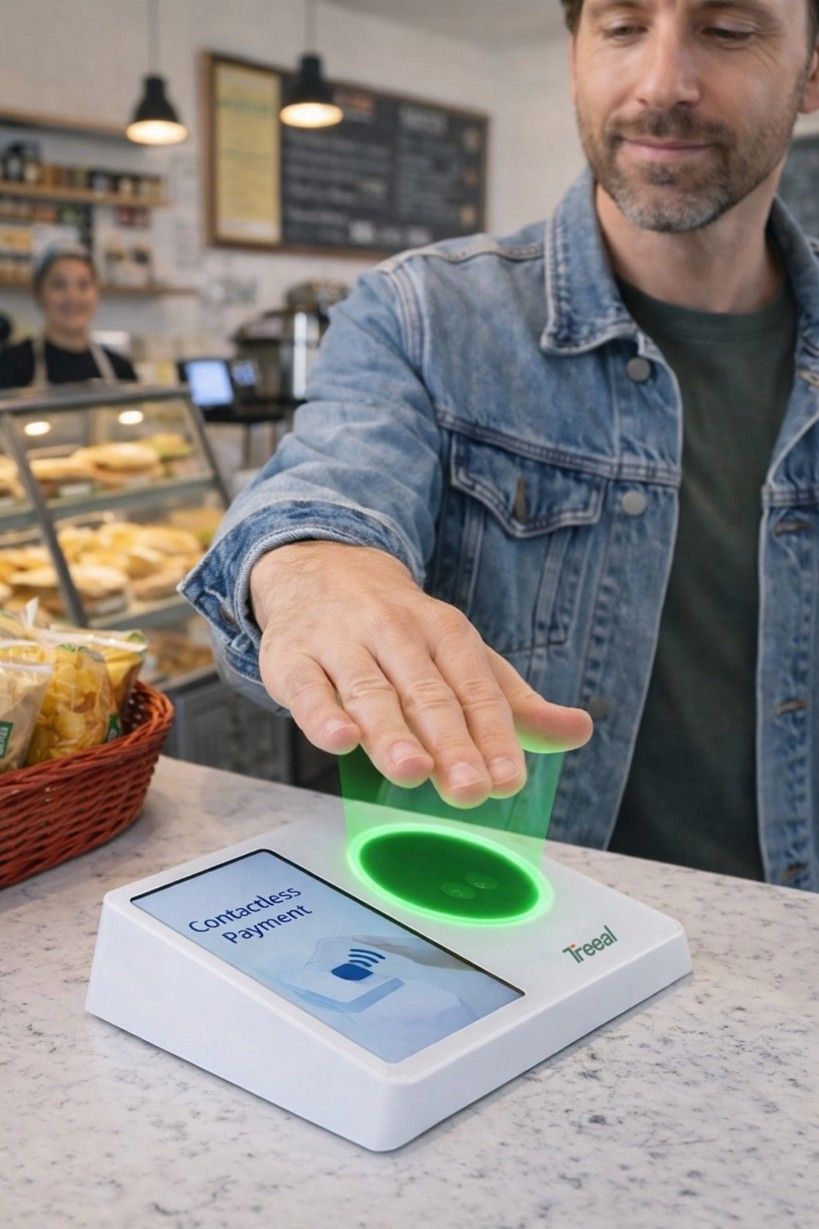
Palm payment is an AI-powered contactless transaction technology that uses palm print and palm vein dual-modal recognition as the payment credential. Treeal, a Brazilian fintech specializing in payment solutions for businesses, partnered with Tencent Cloud to introduce Tencent PalmAI to the Brazilian market — offering merchants and consumers a secure, contactless alternative to fingerprint and face recognition for payment and access control.
At a Glance
| Dimension | Detail |
|---|---|
| Client | Treeal |
| Industry | Fintech / Payment Solutions for Businesses |
| Region | Brazil |
| Challenge | Bringing a contactless, fraud-resistant biometric payment method to Brazilian merchants where fingerprint and face recognition fall short |
| Solution | Tencent PalmAI palm recognition service introduced through the Treeal × Tencent Cloud partnership |
| Key Result | First-of-its-kind palm payment and access offering for Brazilian businesses, announced through global PR coverage |
| Announcement | February 2026, covered by Yahoo Finance, TechNode Global, Bastille Post and others |
Why Brazilian Merchants Need a Better Biometric Than Fingerprint or Face
Treeal is a Brazilian fintech company that builds payment solutions for businesses — connecting merchants, acquirers, and end customers with modern transaction infrastructure. As palm-based identity becomes a global standard for retail, hospitality and access control, Treeal looked for a way to bring this experience to Latin America without inheriting the limitations of older biometrics.
In Brazil, fingerprint and facial recognition are already widely used at ATMs, banks and government services — but each carries operational and trust gaps that matter at the point of payment.
Before PalmAI:
| Pain point | Business impact |
|---|---|
| Fingerprint readers fail with wet, dry, calloused or aging hands | Failed transactions, queue backups at busy retail counters |
| Face recognition raises privacy and consent concerns at the checkout | Customer hesitation, regulatory scrutiny under Brazil's LGPD |
| Card-and-PIN flows are vulnerable to skimming and shoulder-surfing | Chargeback losses, fraud disputes, eroded trust in self-service kiosks |
| Each channel (POS, kiosk, access gate) needs its own credential | Fragmented customer experience, higher operating cost for merchants |
For a fintech serving Brazilian businesses, the opportunity was clear: introduce a payment-grade biometric that is contactless by design, harder to spoof, and compatible with privacy expectations — and make it the same credential a customer can use across payment, access and loyalty.
→ Explore PalmAI's finance and payment solutions
Why Treeal Chose Palm Over Fingerprint and Face for the Brazilian Market
Treeal evaluated the leading biometric modalities used in Latin American payments before partnering with Tencent Cloud. The decision was less about which technology is "best in a lab" and more about which one removes friction at a real Brazilian checkout — without forcing the consumer into a face scan.
Palm Recognition vs Alternatives for Brazilian Payment Environments
| Criterion | Card + PIN | Fingerprint | Face Recognition | Palm Recognition |
|---|---|---|---|---|
| Contactless | No — card insert + keypad | No — finger touches sensor | Yes — but always-on cameras | Yes — hand never touches the device |
| Spoofing resistance | Low — magnetic stripes copyable, PINs observable | Medium — silicone replicas exist | Medium — photos, masks and deepfakes | High — sub-dermal vein patterns cannot be photographed |
| Privacy posture | Card data only | Surface biometric | Faces are highly identifying, raise LGPD concerns | Palms are non-identifying outside the system, opt-in only |
| Condition tolerance | N/A | Fails with wet/dry/worn hands | Affected by lighting, masks, glasses | Works with normal lighting and natural hand position |
| Cross-channel use | One card per network | Device-bound enrollment | Privacy barriers limit reuse | One enrollment for payment, access, loyalty |
Where palm recognition is not the right fit: For very low-value tap-to-pay micro-transactions where enrollment friction outweighs benefit, or for users under 8 whose vein patterns may not be fully developed, card and QR fallback remain appropriate.
Based on this evaluation, Treeal selected Tencent PalmAI as the palm recognition engine for its Brazilian launch:
- Designed to outperform traditional biometrics — dual-modal palm print + palm vein verification is harder to spoof than fingerprint or face alone
- Truly contactless — no surface contact required, an important hygiene and accessibility benefit at high-traffic retail
- Privacy-aligned with LGPD expectations — palm templates are encrypted feature vectors, not images, and require explicit user enrollment
- Built for payment scale — Tencent PalmAI's finance-grade architecture is engineered for high-volume transaction environments
- One credential, multiple use cases — the same palm enrollment can authorize payment, access, and account login across Treeal's merchant network
Inside the Treeal × Tencent Cloud Palm Payment Launch in Brazil
In February 2026, Treeal and Tencent Cloud publicly announced the partnership to bring Tencent PalmAI to Brazil, positioning it as a next-generation alternative to fingerprint and facial recognition for payment processing and access control.
Solution overview:
| Component | Detail |
|---|---|
| Service | Tencent PalmAI — palm print + palm vein dual-modal recognition |
| Target use cases | Retail palm payment, secure access control, account verification for Brazilian businesses |
| Verification flow | One-time palm enrollment → contactless palm scan at the point of transaction |
| Privacy model | Encrypted palm templates only; no raw images stored, no server-side facial data collected |
| Go-to-market | Treeal as the local fintech partner; Tencent Cloud providing the underlying PalmAI service |
How a Brazilian merchant deployment looks:
1. Palm payment at the point of sale
A returning customer registers their palm once at a Treeal-enabled terminal. On future visits, the customer waves their hand over the device — no card, no phone, no PIN — and the transaction is authorized in roughly a second.
2. Palm-based access for businesses
Office buildings, gyms, co-working spaces and member-only venues can use the same palm credential to grant entry without badges or QR codes — extending Treeal's payment relationship into access control.
3. Account verification for digital channels
For digital-physical hybrid services, palm recognition can serve as a step-up verification method when a customer needs a stronger signal than a password — without forcing them through a face scan.
What the Launch Means for Brazilian Businesses
Treeal's launch makes palm recognition concretely available to Brazilian businesses for the first time, and reframes the local biometric conversation around three shifts.
| Shift | Before | After |
|---|---|---|
| Default biometric for in-person payment | Fingerprint or face | Contactless palm wave |
| Privacy posture at the checkout | Face data collected by default | Opt-in palm template, no facial capture |
| Credential per merchant scenario | Card per network, app per service | Single palm enrollment reusable across payment and access |
| Resilience to common biometric failures | Wet/dry hand, mask, low light all degrade accuracy | Works with normal hand presentation in standard retail lighting |
| International payment innovation | Mostly imported cards / QR | Palm payment now part of Brazil's contactless toolkit |
What Brazilian Fintechs Should Evaluate Before Launching Palm Payment
Before adopting palm recognition at scale, fintechs and merchants in Brazil should think through:
- LGPD alignment — confirm that palm biometric collection, storage and processing are described in your privacy notice, and that user consent is explicit and revocable
- Enrollment UX — first-time palm registration should feel as quick as setting up a new card; under 30 seconds end-to-end is a reasonable target
- Fallback methods — keep card / QR / PIN options available so that customers who choose not to enroll are never blocked
- Network and offline behavior — define how terminals behave during connectivity dips, and what audit trail is preserved
- Merchant education — front-line staff need a simple script to explain "what is the palm, where does my data go, and what if I refuse"
- Acquirer and certification path — coordinate with payment networks and acquirers on how palm-authorized transactions are routed and reconciled
These questions matter more than raw accuracy numbers in determining whether a Brazilian rollout actually succeeds.
Where Palm Payment Goes Next in Latin America
Brazil is one of the world's most active digital payment markets, with PIX driving widespread adoption of instant transfers. Palm recognition complements rather than replaces this trend: it gives merchants a way to authenticate the human at the counter, while PIX and card networks continue to move the money behind the scenes. As palm-based payment becomes part of the contactless toolkit across Latin America, Treeal and Tencent Cloud are positioning Brazilian businesses to participate in that shift from day one.
→ Ready to bring palm payment to your business in Brazil or Latin America? Use the contact form on this page to discuss your fintech or merchant deployment.
Media Coverage
- Tencent Cloud and Treeal partnership brings next-gen PalmAI service to Brazil — Tencent Cloud News
- Tencent Cloud and Treeal partnership brings next-gen PalmAI service to Brazil — Yahoo Finance
- Tencent Cloud and Treeal partnership brings next-gen PalmAI service to Brazil — TechNode Global
- Tencent Cloud and Treeal partnership brings next-gen PalmAI service to Brazil — Bastille Post Global
- Treeal × Tencent Cloud — LinkedIn announcement
- Treeal × Tencent Cloud — X / Twitter announcement
- Treeal × Tencent Cloud — YouTube short
- Treeal × Tencent Cloud — Facebook announcement
- Treeal corporate site
FAQ
How does palm payment work for Brazilian merchants and customers?
Palm payment uses Tencent PalmAI's dual-modal recognition — combining palm print and palm vein patterns — to verify a customer's identity in roughly one second. The customer enrolls their palm once at a Treeal-enabled terminal, linking it to their payment account. At checkout, they hover their hand over the device and the transaction is authorized without inserting a card, entering a PIN, or scanning their face.
Is palm recognition more private than face recognition under Brazil's LGPD?
Palm recognition is generally easier to align with LGPD expectations than face recognition for a simple reason: a palm is not a primary identifier in everyday life, so capturing it is more clearly opt-in. PalmAI also stores palm data as encrypted mathematical templates rather than raw images, and the palm template cannot be reverse-engineered into a usable picture. With face recognition, by contrast, customers may feel they are being scanned without explicit consent.
How does palm payment compare to fingerprint and face recognition for businesses?
Compared to fingerprint, palm payment is fully contactless and works reliably with wet, dry, calloused or aging hands. Compared to face recognition, palm payment does not require capturing a customer's face at the checkout, which reduces privacy concerns and aligns better with consent-based payment flows. The Treeal × Tencent Cloud announcement explicitly positions Tencent PalmAI as a system "designed to outperform traditional biometric methods, including fingerprint and facial recognition".
What kind of businesses in Brazil can use Treeal's palm payment?
Treeal's palm payment offering is designed for Brazilian businesses that already work with payment terminals, kiosks or access systems — including retail merchants, hospitality venues, member-based services, and operators of secure facilities. The same palm enrollment can authorize payment, access, and verification across these scenarios.
How can a Brazilian fintech or merchant get started with PalmAI through Treeal?
Use the contact form on this page to start a conversation about palm payment deployment. Tencent PalmAI works directly with payment partners, system integrators and merchants on integration planning, hardware sourcing (M3 / M4 palm recognition modules) and rollout — with Treeal as the local Brazilian partner for in-market deployment.
Related Resources
Other PalmAI palm payment deployments worth comparing:
Other PalmAI palm payment deployments:
- Positivo Tecnologia builds Brazil's first palm-based Pix terminal — same market, complementary use case (smart payment terminal)
- Opensys brings palm payment to Malaysian retail and ATMs — fellow payment integrator across multiple channels
- How 7-Eleven achieved 25% faster checkout with palm payment — proven palm payment scale at convenience-retail level
- How Visa is launching palm payment in Singapore — international card-network adoption of palm payment
Decision-support reading:
- Read: Palm Recognition vs Face Recognition — Privacy and Security Compared — why palm fits LGPD-style consent-based payment better than face
→ Browse all PalmAI success stories
About Tencent PalmAI
Tencent PalmAI is an AI-powered palm recognition service that combines palm print and palm vein dual-modal identification. Developed by Tencent's YouTu Lab and AI Lab — with 20+ top conference publications, 90+ granted patents, and 400+ pending — PalmAI powers contactless identity verification, payment, and access control for enterprises across retail, finance, healthcare, and smart building sectors worldwide. The Treeal partnership brings this capability to Brazilian businesses, giving local fintechs and merchants a contactless biometric option that is engineered to outperform fingerprint and face recognition at the point of payment.