Visa Partners with Tencent PalmAI to Launch Palm Payment in Singapore
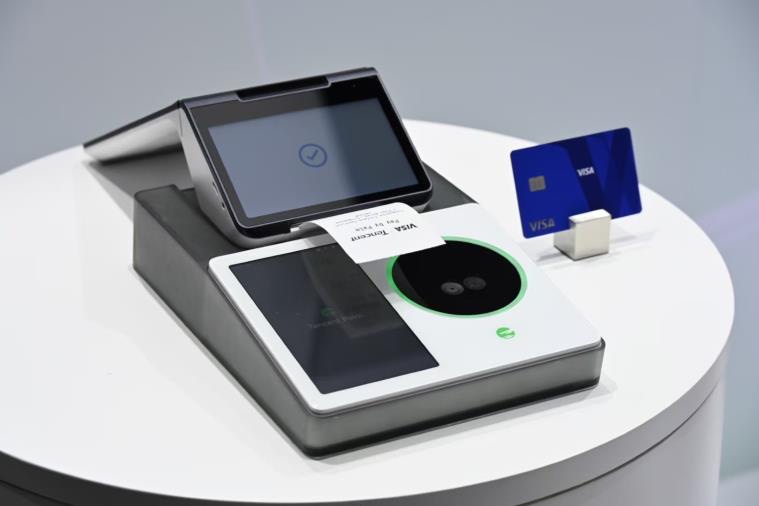
Palm payment is an AI-powered contactless transaction method that combines palm print and palm vein recognition as the payment credential. Visa, the world's leading payment network, partnered with Tencent PalmAI to bring palm-based payment to the international market — starting with Singapore, where users link their bank cards to their palm and pay with a simple hand wave.
At a Glance
| Dimension | Detail |
|---|---|
| Client | Visa |
| Industry | Global Payment Network |
| Region | Singapore (international launch market) |
| Challenge | Expanding contactless payment beyond cards and phones in a market demanding faster, more secure transaction methods |
| Solution | Tencent PalmAI PayMax — palm recognition integrated with Visa's card network for card-linked palm payment |
| Key Result | World's first Visa-linked palm payment system — enabling cardless, phone-free payments via palm wave |
| Milestone | Announced at the 9th Singapore Fintech Festival |
Why Cards and Phones Are No Longer Enough for Next-Gen Payment
Visa, the world's largest payment network processing over 200 billion transactions annually, has long led the evolution from magnetic stripe to chip to contactless tap. Yet even NFC tap-to-pay depends on carrying a physical card or charged smartphone — creating friction for consumers who forget their wallet, run out of phone battery, or prefer a completely device-free checkout.
Singapore, with its high smartphone penetration and forward-leaning fintech ecosystem, became the logical testing ground for the next frontier: paying with nothing but your hand.
Before palm payment:
| Pain point | Business impact |
|---|---|
| Contactless tap still requires a card or phone | Transactions fail when device unavailable or battery dead |
| Card fraud persists (stolen cards, unauthorized contactless taps) | Chargebacks and consumer distrust |
| Checkout friction in high-throughput retail | Queue buildup during peak hours |
| Multiple credential management (cards, apps, tokens) | Consumer fatigue and abandoned transactions |
→ Explore PalmAI's finance and banking solutions
Why Visa Chose Palm Recognition Over Other Modalities
Visa evaluated biometric payment modalities that could complement its existing card network — adding a layer that is inherently tied to the individual, impossible to leave at home, and resistant to fraud.
Palm Payment vs Alternatives for International Payment Networks
| Criterion | Card + NFC Tap | Fingerprint | Face Recognition | Palm Recognition |
|---|---|---|---|---|
| Device dependency | Requires card or phone | Requires enrolled device | Camera infrastructure needed | No device required — palm is the credential |
| Fraud resistance | Card can be stolen/cloned | Silicone replicas possible | Spoofable with photos/deepfakes | Sub-dermal veins — cannot be copied externally |
| Contactless | Yes (NFC) | No — finger presses sensor | Yes — but raises privacy/surveillance concerns | Yes — no surface contact, no camera pointed at face |
| Universal accessibility | Requires bank account + issued card | Device-bound enrollment | Privacy regulations limit adoption in public spaces | Works for all ages 8–100, no device needed |
| Speed | 1–2s (tap + auth) | 2–3s (press + hold) | 1–2s (when conditions optimal) | ~1s palm wave |
Where palm payment is not yet the default: For online/e-commerce transactions, card credentials remain primary. Palm recognition currently targets in-person payment scenarios where device-free convenience and fraud resistance deliver the most value.
Visa selected Tencent PalmAI for its:
- Dual-modal precision — palm print + palm vein combined achieves FAR of 1 in 100 million, meeting financial-network security thresholds
- Card-linkable architecture — PalmAI's PayMax platform supports binding existing Visa cards to a palm enrollment, preserving the existing card-network economics
- Proven scale — PalmAI already powers millions of palm payment transactions in China's retail ecosystem
- Privacy-first design — palm data stored as encrypted templates, never as images; data cannot be reverse-engineered
How Visa-Linked Palm Payment Works: Enroll Once, Wave to Pay
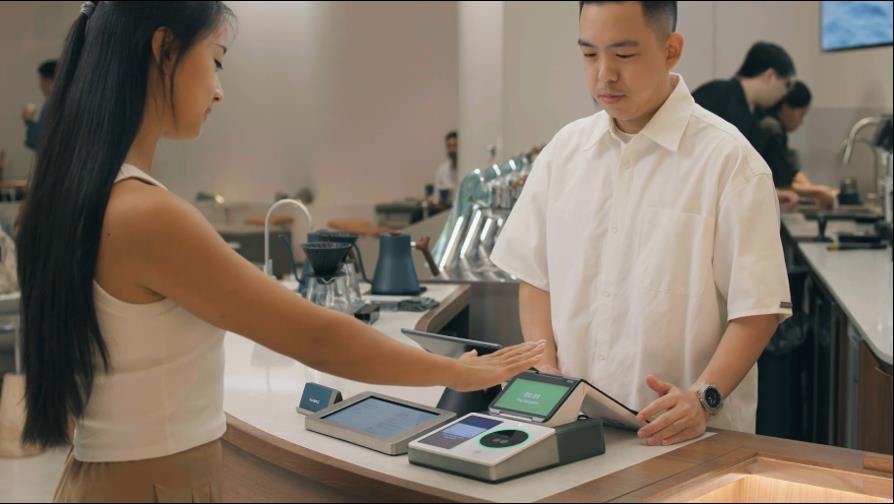
Tencent PalmAI's PayMax platform powers the Visa palm payment integration, connecting palm recognition directly to Visa's card processing network.
Technical implementation:
| Component | Detail |
|---|---|
| Biometric modality | Palm print + palm vein (dual-modal) |
| Payment network | Visa card network — existing card linked to palm enrollment |
| Solution tier | PalmAI PayMax (cloud-based, high-volume transaction processing) |
| Verification speed | ~1 second from palm presentation to authorization |
| Security standard | FAR 1 in 100M, Finance-grade encryption |
| Enrollment process | On-device guided enrollment — bank card + palm binding in one flow |
User journey:
- Enroll — At a PalmAI device, follow on-screen prompts to simultaneously bind a Visa card and register palm biometrics
- Activate — Once linked, the palm becomes the payment credential for that Visa account
- Pay — At any palm-enabled merchant terminal, wave palm to complete transaction — no card, no phone, no PIN needed
First International Market: Visa + PalmAI at Singapore Fintech Festival
| Metric | Traditional contactless (NFC tap) | Palm payment (Visa + PalmAI) | Advantage |
|---|---|---|---|
| Device requirement | Card or phone mandatory | No device needed | True device-free |
| Payment speed | 1–2s (tap + auth) | ~1s palm wave | Comparable or faster |
| Fraud vector | Card skimming, stolen NFC device | No physical credential to steal | Inherently fraud-resistant |
| User enrollment | Already have card | One-time 30s palm enrollment | Minimal onboarding |
| Cross-border potential | Card works globally | Palm + card linkage works at any enabled terminal | Network-portable |
What Payment Networks Should Consider Before Deploying Palm Payment
Before extending palm-based payment across merchant networks, payment processors should evaluate:
- Card-linkage architecture — how palm enrollment integrates with existing card tokenization infrastructure (Visa Token Service, network tokens)
- Merchant terminal compatibility — whether existing POS hardware can accommodate a palm recognition module or requires new terminals
- Consumer enrollment incentives — palm payment adoption requires first-time registration; consider promotional campaigns or loyalty bonuses to drive initial sign-ups
- Regulatory landscape — biometric data collection requirements vary by market (PDPA in Singapore, GDPR in EU); pre-clear with local data protection authorities
- Fallback coexistence — palm payment should run alongside card tap, not replace it, during the transition period
What's Next for Visa and PalmAI in International Markets
As the palm payment ecosystem matures, the Visa-PalmAI partnership opens a pathway for card-linked palm payment to expand beyond Singapore into additional markets across Asia-Pacific and globally. The vision: any Visa cardholder, anywhere, can enroll their palm and enjoy device-free payment at participating merchants — retaining the trust and economics of the Visa network while eliminating the need to carry anything at all.
→ Ready to bring palm payment to your payment network? Discuss palm recognition integration for your financial infrastructure using the contact form on this page.
FAQ
How does Visa-linked palm payment work in Singapore?
Visa-linked palm payment uses Tencent PalmAI's dual-modal recognition — combining palm print and palm vein patterns — to verify a user's identity and authorize a payment linked to their Visa card. Users enroll once at a PalmAI device, binding their Visa card to their palm biometrics. After enrollment, they pay at any palm-enabled terminal by hovering their hand — no card, phone, or PIN required. Authorization completes in approximately 1 second.
Is palm recognition more secure than NFC contactless tap for payment?
Palm vein patterns are sub-dermal biological signals that cannot be photographed, skimmed, or externally replicated — unlike physical cards that can be cloned or NFC-enabled phones that can be stolen. Tencent PalmAI achieves a False Acceptance Rate of 1 in 100 million (FAR 0.000001%), exceeding the security requirements of international payment networks. Because no physical credential exists, the entire category of "lost/stolen card" fraud is eliminated.
How long does it take to deploy PalmAI palm payment across a merchant network?
Deployment timelines depend on terminal fleet size and integration approach. The PalmAI PayMax platform provides APIs and SDKs that integrate with existing payment middleware. For merchant networks with compatible hardware, palm recognition modules can be added to existing terminals. New installations typically require terminal replacement or upgrade. Visa and Tencent PalmAI are working together to define the merchant onboarding pathway for the Singapore market.
Can users still pay with their Visa card if palm payment is available?
Yes. Palm payment is additive — it does not replace card tap or other existing Visa payment methods. Merchants with palm-enabled terminals continue to accept all standard Visa payment methods. Consumers choose whether to wave their palm or tap their card, depending on preference and whether they have enrolled.
What happens to palm biometric data in the Visa-PalmAI system?
PalmAI converts the palm scan into an encrypted mathematical template (feature vector) during enrollment. The raw palm image is discarded immediately — no photograph is stored. The encrypted template cannot be reverse-engineered into a palm image. Data handling complies with Singapore's Personal Data Protection Act (PDPA) and Visa's data security standards.
Related Success Stories
Other PalmAI palm payment deployments worth comparing:
- How 7-Eleven achieved 25% faster checkout with palm payment — proven palm payment scale at convenience-retail level (1,500 stores in 1 month)
- Opensys brings palm payment to Malaysian retail and ATMs — multi-channel palm payment across retail, EV charging, and ATM
- Treeal brings palm payment to Brazilian businesses — fintech-led palm payment rollout in Latin America
→ Browse all PalmAI success stories
About Tencent PalmAI
Tencent PalmAI is an AI-powered palm recognition service that combines palm print and palm vein dual-modal identification. Developed by Tencent's YouTu Lab and AI Lab — with 20+ top conference publications, 90+ granted patents, and 400+ pending — PalmAI powers contactless identity verification, payment, and access control across retail, finance, healthcare, and smart building sectors worldwide. The Visa partnership demonstrates how palm recognition integrates with global payment networks to deliver the next generation of device-free, fraud-resistant transactions.